


If you’re a landscape architect, I’m 100% sure you’ve been asked by at least one client to include lots of trees to make a project “sustainable”.
And I’m sure you fully believe that a park without trees is anything but “sustainable”. I do, too.
However, I add this: a project does not necessarily become “sustainable” just because it has trees.
By itself, a tree can never be sustainable.
Scream “blasphemy!” all you want, but it’s true. Trees cannot be sustainable. No, they cannot, because sustainability was never a property of individual components.
Rather, sustainability is a property of systems!
“A Tree is Not Sustainable” is not Blasphemy
It is not the trees themselves that are sustainable.
What’s sustainable is how the trees take out excess CO2 and other pollutants from the air, offsetting the emissions from cars in the area, and improving the health of joggers and park-goers.
On the other hand, a lot of studies have shown that urban trees can actually become a source of carbon emissions.
Yes, all because of tree maintenance decisions: the frequency of cutting branches, the type of equipment used, and the amount of gasoline consumed to power the chainsaws and the pick-up truck driving the laborers around. (See: Kendall & McPherson, 2012; Fang et al, 2007; Nowak et al, 2002)
Another example: Oh look, these porous pavers are labelled “sustainable”!
Does that mean specifying them automatically makes your project sustainable? Perhaps, unless you have a lapse in judgement and set the porous pavers…above a concrete slab. D’oh.
It’s not the material itself that is sustainable, but the fact that using it in lieu of an impervious one like asphalt allows stormwater to pass through instead of runoff on the surface.
Thus, very intense flash floods are less likely to ravage a site.
Often, we laud landscape elements or materials as “sustainable” and “eco-friendly”.
Whether they be plants, stone, concrete, metal, a screw, a machine, a door, a gazebo, a plaza, a store, maintenance personnel, or whatever, we cannot just say that each one of these is a sustainable component. Individually, they cannot possess that specific property.
But these components of a whole project, put together and interacting with one another, working as one? Now that can be sustainable.
An Introduction to Systems
This compendium of individual components and processes that closely interact with one another to fulfill some function or purpose is called a system.
A swimming pool, a pool pump, drain inlets, PVC pipes, a connection to the municipal water supply, electrical supply to power the pump, chlorine application, sieving of floating debris, and cleansing of gunk from the tiles and pipes.
These all comprise a “swimming pool system” that allows pool water to be suitable for swimming.
Yes, even the act of maintaining is part of the system. Otherwise, the pool fouls up so much it is no longer useable as a swimming pool.
In that case, the swimming pool fails as a functioning system.
Nested Systems
Complex systems can be broken down into subsystems
Each component of the swimming pool can be a system in itself.
The swimming pool system could be subdivided into a water supply system, water recycling system, and sterilization system.
In the same vein, the swimming pool system itself can be a subsystem for a larger system, like say a “condominium amenities system”.
System Boundaries
So how do we establish what to include in the system? What are the system boundaries?
Any component that influences how a system does its thing can be part of a system.
This includes components that are obviously outside the property lines of your project site. The physical boundaries of a site do not necessarily jive with the functional boundaries of the system in question.
Most ecological systems don’t give a damn about human-imposed boundaries.
You’ll often see cases such as Marikina City struggling to mitigate their floods, when in the first place the rainwater originates from the highlands of the adjacent Rizal region.
As landscape architects we must commit this to memory so that the systems in our projects don’t fall short of functioning.
Inputs and Outputs
In a system, materials, energy, and information “flow” from one component to another.
Materials, as in water and nutrients.
Energy, as in heat and potential energy.
Information, as in how stuff like temperature and air humidity tell a plant that it’s time to sprout again.
These flows represent the interactions between the system components.
These flows may be inputs (coming from outside to inside the system) or they can be outputs (going out from within the system).
When the system outputs become the inputs of that same system, what we get is a feedback loop.
This is where the magic happens. Through feedback loops, whole systems can transform and reach a certain state that makes it work better…or totally go bonkers.
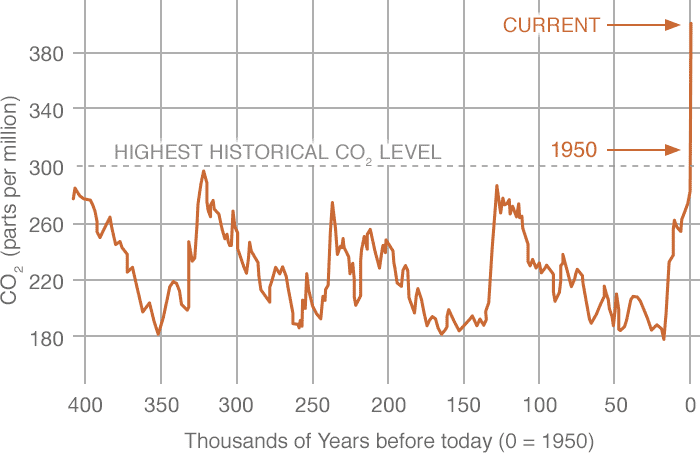
Positive feedback loops (“self-reinforcing”) is what allows phenomena like aphid populations to explode and destroy ornamental landscaping, or global temperatures that keep on rising and destroying ecosystems that act as carbon sinks.
Negative feedback loops (“self-balancing”) is what keeps these phenomena in check. Aphid populations will keep on growing unless predators like ladybugs come into the picture and eat them all up, protecting your precious ornamental plants.
Global temperatures rise because there’s too much CO2 (and other greenhouse gases) in the atmosphere, but large swaths of forests can sequester the CO2, which would help the mercury drop.
Emergent Property
This is sustainability.
Not the tree on its own. Not the ladybug by itself.
Rather, it is how they interact with other components to help maintain a system that is greater than themselves.
Sustainability is a property not of the individual component, but of the whole system.
In other words, sustainability is an emergent property.
In simple terms, an emergent property is a property that is evident only when we look at the system as one whole entity,rather than a mere collection of individual parts.
The individual components do not and cannot possess an emergent property.
Have you heard of the saying, “the whole is more than the sum of its parts”? That sums up what an emergent property is.
Besides sustainability, other emergent properties include: productivity, stability, autonomy, equitability, solidarity, power (political or social), and even quality of life.
I’d argue that “safety” and “security” are also emergent properties.
After all, it’s not merely the security cameras, high fences, well-lit walkways, ever-present security guards, and low shrubs that disallow hiding that make a public area safe secure, but all of them functioning together as one whole.
Applying Systems-Thinking in Landscape Design
Problems are never as simple as they seem.
All too often, we try to supply a solution based on a too-simplistic and too-linear point of view. What happens is we end up making the problem worse. Case-in-point:
Ah, lots of mosquitoes in your residential garden? Let’s fumigate that b****! Oh no, we just helped poison the lake downstream. Oh no, we just killed the beneficial insects in our garden. Oh no, the aquifer was contaminated. There goes our fish, our drinking water, and the local ecosystem. Hey look, the mosquitoes are back.
Crud.
We took out the mosquitoes through brunt and direct means. That should’ve taken care of the problem, right?
Maybe, unless these pests aren’t the heart of the problem. Let’s adopt a different approach:
The mosquitoes thrive in your site, you say?
Hey, the soil is always wet and full of puddles. Perhaps all that stagnant water lets the mosquitoes breed like crazy? Why is there stagnant water?
Could be because your soil is clayey, and rainwater can’t percolate down to the aquifer? Maybe the water table is too close to the surface? That can keep the soil consistently wet.
Or maybe your site is perched at the base of a valley? All that rainwater from up the slope flows down and through the valley.
That means your lot is a bucket beneath a leaking faucet.

A lot of stuff to think about! What do we do?
We can regrade the slope so that it drains into gutters and catchment basins placed throughout the site.
We’ll make sure the water doesn’t stay put for too long in them.
Is the client super queasy? If not, then we can also recreate a pond ecosystem where frogs, fish, and dragonflies can thrive on mosquitoes and their wrigglers.
Of course, add plants so that these predators have a habitat with fresh, clean (not sterile!), oxygenated water and lots of hiding places to breed and raise their young.
This pond ecosystem can also double as a retention pond if you decide to regrade the site to slope towards it.
Make sure the client maintains it every now and then by removing excess soil and organic matter from the bottom of the pond.
Overall, this would be a more effective and creative approach to managing an insect pest, not to mention more attractive and economical.
We essentially turned a problem into a resource, i.e. an output into an input!
Best part? You don’t end up poisoning the drinking water.
Of course, the source of the problem could very well be stagnant water outside the physical boundaries of the site – perhaps your client’s neighbor, or a nearby creek.
Fumigation might be a more plausible approach in that scenario. Still, knocking on the doors of your neighbor or barangay hall and asking for a favor is still an option.
Systems-Thinking
What just happened there is an example of systems-thinking, an approach to problem-solving.
Systems-thinking equals looking at the big picture.
The point of that example is to show that through systems-thinking, you open a plethora of strategies to resolve one or multiple problems.
Linear-thinking tells us that the mosquitoes are the only problem. Systems-thinking lets us realize that other factors are at play.
Systems-thinking does not look at the components one-by-one.
Systems-thinking looks at the relationships between these components.
Conclusion
The landscapes we design are more than a mere collection of plants, pavers, soil, lighting fixtures, water features, and people.
The landscapes that we landscape architects design are systems. Yes, landscape architects design ecosystems!
Even if you don’t mean to, the fact is that the human system is forever linked to the natural systems.
Rather than ignore this reality, we ought to adopt a systems-thinking approach whenever we design and manage landscapes. Not only will we arrive at the heart of the problem, but we’d also gain a better appreciation of the complex dynamics of your projects.
So next time, when faced with an issue in your site, do take a step back. Take a nice, deep breath. Appreciate the complexity of the system. See the big picture.
Now, I challenge you to apply systems-thinking in any aspect of your career or personal life. Think of a problem – high water bills, disgruntled employees, or a bad habit.
Try to look at them from a systems-thinking approach. I’m sure you’ll be surprised with the solutions you discover yourself.
Let me know down in the comments how you’ve applied systems-thinking in your life. I’m eager to hear from you, fabled readers.

 Decosys
3 thoughts on “Systems-thinking in Landscape Design: Seeing the Big Picture”